Two weeks ago, we reported on the release of the Detroit Future City plan, the result of years of work by the Detroit Economic Growth Corporation and a host of other agencies and community groups. The plan lays out an ambitious vision for the future of Detroit over the next fifty years that would truly transform the social, environmental, and economic landscape of the city.
We’ll be exploring how U-Haul fits into that vision of Detroit’s future over the next few months.
Land and Building Assets
The plan has many sections—this entry will focus on how the U-Haul New Center project complements Detroit Future City’s “Transformative Ideas: Land and Building Assets” section. This section voices an important idea about buildings and land:
All land, whatever its legal ownership, is public in the sense that how it is used and maintained affects its neighbors and the community as a whole, and affects the city’s ability to preserve its neighborhoods and build its economy.
Anyone who knows Detroit knows that one of the city’s greatest challenges is the enormous amount of vacant land (104,000 of the city’s 385,000 land parcels are vacant) and huge number of unoccupied and, in many cases, unsafe buildings, some of which are historically important, but losing their cultural value as they deteriorate.
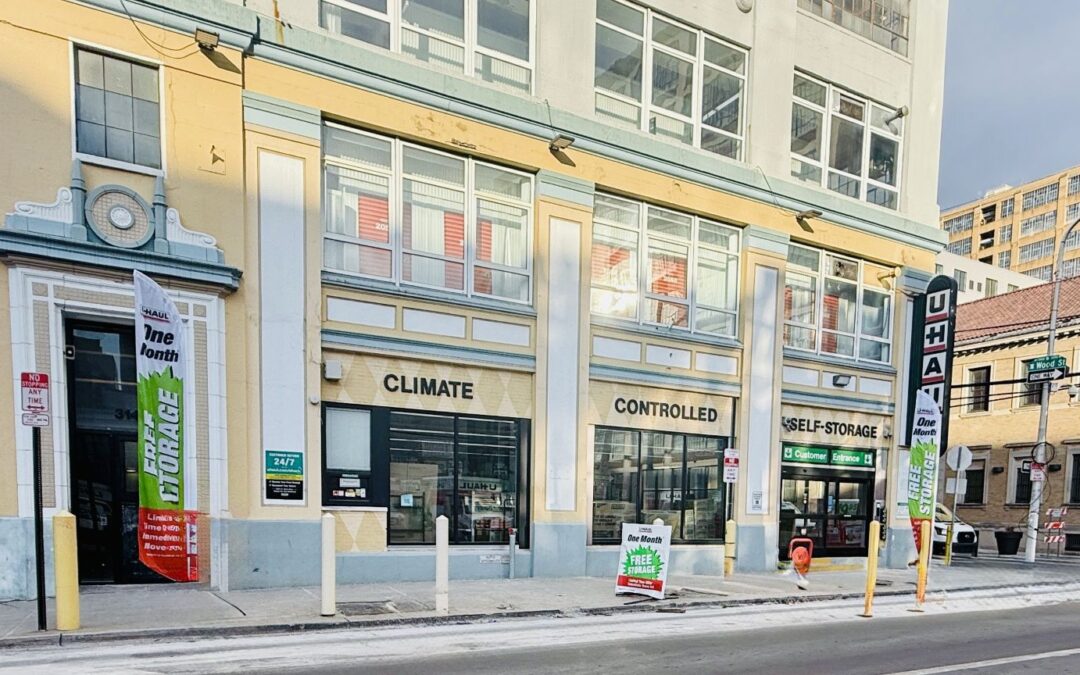
There is an obvious way in which the New Center project fits into this portion of the plan. In rescuing a fine old building of great historical value from the decline that accompanies abandonment, U-Haul has immediately accomplished several things: historic preservation, providing a corner anchor for a neighborhood in transition, and establishing a human presence to combat the blight and criminal activity that gravitate toward empty urban places.
As the plan says, even private property has a public impact through its use and outward appearance, and the reclamation of the most visible building for several blocks in any direction strongly contradicts the message of decline sent by smaller unoccupied buildings nearby.
Enumerating the land use challenges ahead, the Detroit Future City plan laments that the tax foreclosure and public land auction process has perpetuated the disuse of land in the city, and lays out a goal for coordinated revitalization that includes appropriate reuse as one of its elements. In returning the Nabisco building to active, vital use, U-Haul has essentially laid one of the first bricks for this path.

To read our previous posts about the Detroit Future City plan, click here.
What are your thoughts on the future of Detroit? What kinds of changes would you like to see in the next 10 years? Let us know in the comment section below.
~Joseph
Joseph Tangari, our new research assistant in Detroit. Joe is a five-star master-degree graduate student in the Department of Urban Studies at Wayne State University.